Most HR software is designed around a company that has one shift, one wage type and one attendance policy, with everything else treated as an exception to configure around. A security guard company is the opposite of that company. Every guard is potentially on a different shift, a different site, a different wage basis, and a different overtime situation — on the same day. Generic HRMS software copes with this by forcing it into a shape it was not built for. A system built for guarding starts from the reality instead.
Why guarding is a genuinely different problem, not just "more shifts"
Three things are true of almost every guarding operation and almost no office:
- Coverage cannot have a gap. A post is either manned or it is not; there is no equivalent of "the work will get done eventually." That makes shift assignment a compliance and contractual obligation, not just a scheduling convenience.
- Wages are frequently hourly or per-duty, and often mixed with monthly-salaried supervisors in the same company. A single payroll run has to handle both correctly, at the same time.
- Overtime is routine, not exceptional. A relief guard arriving late, an extended posting, a client asking for extra coverage — these happen constantly, and they all produce a real overtime liability that has to be priced and recorded, not absorbed into a flat "duty allowance."
Per-guard shift assignment, not one shift for the whole company
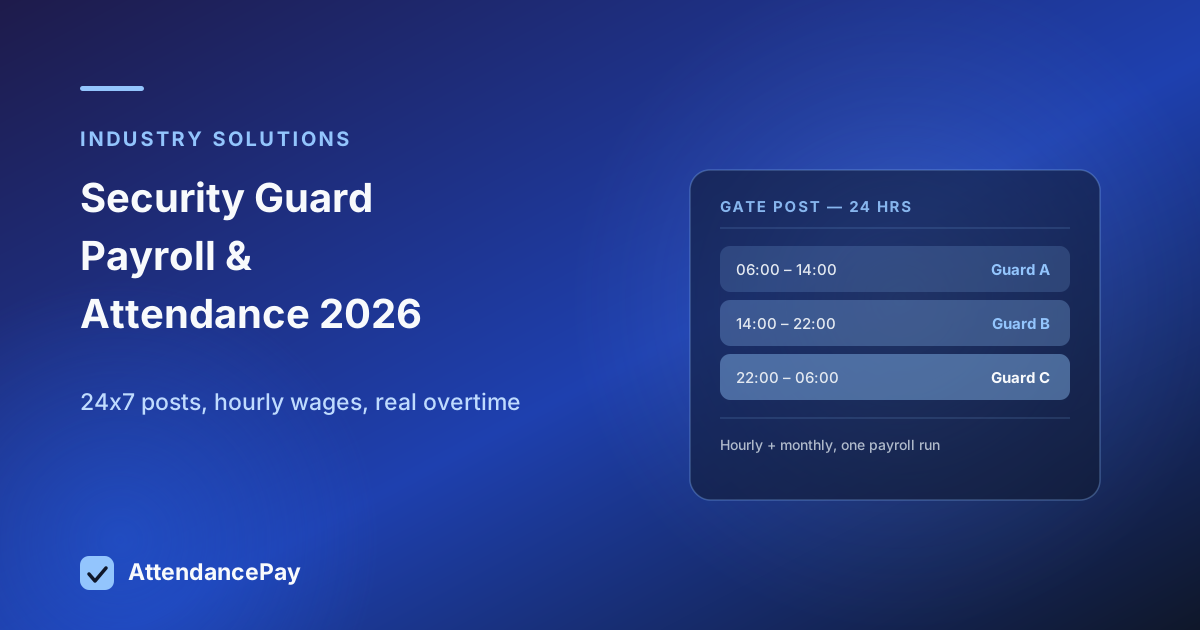
Every guard can be assigned their own shift — a standing pattern for a regular posting, or a specific shift for a specific date when they are moved to cover a gap. This is not a company-wide setting with a few overrides; it is how assignment works by default, because in a guarding operation "the whole company works one shift" is never actually true. When a guard is repositioned from a day post to a night post for a week, that is a normal, first-class change — not a workaround.
What this actually buys a guarding company is straightforward: a guard's late mark, worked hours and overtime are all evaluated against the shift they were genuinely posted to, not against a single default timing that fits nobody's real roster. The mechanics of how shift assignment works are covered fully in shift and roster management.
Attendance policy per employee — because a supervisor and a site guard are not the same
A guarding company typically runs several genuinely different populations under one roof: site guards on 8- or 12-hour postings, supervisors on a fixed office-style day, and a control room team on rotation. Each of these reasonably needs its own grace period, its own half-day threshold and its own overtime eligibility — not because anyone wants complexity, but because applying an office grace period to a guard posted at a client gate produces the wrong answer for both.
Attendance policy is assigned per employee, with a company default for anyone not specifically configured, so a guarding company can run as many distinct policies as it has genuinely distinct populations, without maintaining parallel systems for each. See attendance policies for the full configuration surface — grace periods, half-day thresholds, regularization windows and overtime eligibility, all explicit rather than left to a supervisor's judgement.
Overtime that actually reflects a guarding operation
Overtime in guarding is not a rare event to be manually approved — it is a structural feature of the business, and it needs to be priced with the same rigor as base pay. A guard held over because the relief is late, a client requesting extended coverage on a weekend, a holiday posting that would otherwise go unmanned — each of these needs a rate that reflects whether it happened on a normal day, a weekend or a holiday, applied consistently rather than negotiated per incident.
Configurable weekend and holiday overtime multipliers, a choice between a fixed overtime rate or one tied to the guard's own pay, and a minimum threshold and daily cap so a short delay does not become an unreviewed payout — all of this is covered in overtime management, and the statutory basis for "twice the ordinary rate" is explained in our guide to overtime pay rules in India.
Hourly and monthly wages, in the same payroll run
Guards paid hourly or per-duty and supervisors paid monthly are, in most guarding companies, on the same payroll cycle — and they need to come out of the same run without one being handled as a manual adjustment. Salary type is set per employee: hourly staff are paid from recorded hours at their configured rate with overtime applied, monthly staff are paid on payable days, and both settle correctly in the same run. The mechanics are covered in payroll management and how attendance becomes payroll.
What to actually check before choosing a system
- Can a guard be reassigned to a different shift for a single date without it being a manual exception?
- Can site guards, supervisors and control-room staff each run under a different attendance policy?
- Are weekend and holiday overtime priced differently, and is there a cap so a data error cannot become an oversized payout?
- Can hourly-paid guards and monthly-paid supervisors be processed in one payroll run?
A guarding company that can answer yes to all four is not looking for "an HRMS with a shift feature" — it has found a system built around how guarding actually runs.