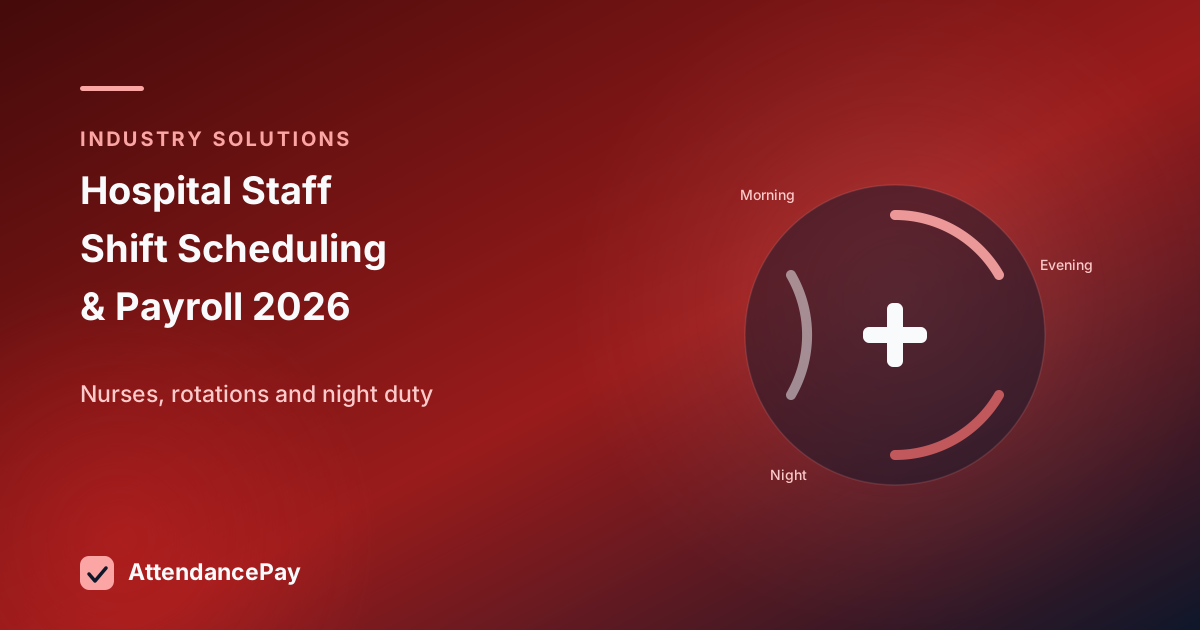
A hospital is not one workforce; it is several, sharing a building. Nurses rotate through morning, evening and night shifts on a pattern that has to guarantee continuous coverage. Doctors keep clinic hours plus on-call time that does not fit a standard shift at all. Administrative and support staff work a conventional day. Treating all of them under one attendance policy and one shift timing does not simplify anything — it just produces wrong answers for whichever group does not match the assumption.
Why "one policy for everyone" fails specifically in healthcare
The problem is not that hospitals are complicated in general — it is that the populations inside a hospital are genuinely different in ways that matter for pay. A nurse's late mark on a night shift and an administrator's late mark on a day shift are not comparable events, and forcing them through the same grace period and the same half-day threshold produces a result nobody would actually choose if they were designing the policy from scratch for each group.
Rotation, assigned per nurse and per date
Nursing rosters rotate — morning this week, night the next — and the pattern has to be visible and correct for every individual nurse, not just tracked informally by a ward in-charge who happens to remember it. Shifts are assigned per employee and per date, so a rotating pattern across a nursing team lives in the system rather than in one person's memory, and a night shift crossing midnight is treated as a single working session rather than splitting into two confusing partial days. This overnight handling matters more in a hospital than almost anywhere else, because clinical night shifts are long, continuous, and the one place attendance software most commonly gets the date arithmetic wrong. The full mechanics are in shift and roster management.
Different policies for different roles, without running separate systems
Nurses on rotation, doctors with on-call arrangements, and administrative staff on a fixed day can each be assigned their own attendance policy — their own grace period, half-day threshold and overtime eligibility — while all three remain in the same hospital-wide system. This is what makes it possible to be strict about administrative punctuality and realistic about the nature of clinical rotation, without one policy quietly distorting the other. See attendance policies for the full configuration.
Night duty and overtime, priced by what actually happened
Night duty allowance and overtime for extended shifts are not edge cases in hospital staffing — they are routine, and they need to be calculated from the actual hours a nurse or attendant worked, not estimated at month end. Weekend and holiday overtime can be priced separately from an ordinary night shift, with a configurable rate — fixed or tied to the employee's own salary — and a cap so an unusual entry does not become an unreviewed payout. This is covered in overtime management, and the underlying statutory logic is explained in overtime pay rules in India.
Payroll for a workforce that is genuinely mixed
Many hospitals pay nursing and support staff on an hourly or per-shift basis while doctors and administrators are on monthly salaries — sometimes even within the same department. A single payroll run needs to handle both correctly, with hourly staff paid from recorded hours and monthly staff paid on payable days, settling together rather than as two separate processes that have to be reconciled by hand afterward. See payroll management and how attendance becomes payroll for how this works end to end.
What to check before choosing a system for a hospital
- Can nursing rotation be assigned per nurse and per date, not just tracked by a ward in-charge informally?
- Are overnight shifts handled as one working session, not split across two calendar days?
- Can nurses, doctors and administrative staff each run under a different attendance policy in the same system?
- Can hourly and monthly-paid staff be processed together in the same payroll run?
A hospital that can answer yes to all four has a system that reflects how clinical staffing actually works — not a generic attendance tool asked to stretch to fit it.