Overtime is unusual among payroll items because the law does most of the work for you. For most other things — allowances, bonuses, leave encashment — you decide the amount within broad limits. For overtime, the statute fixes the rate, and your only real jobs are to know which rate applies, to calculate it on the correct wage base, and to have trustworthy data on how many extra hours were actually worked. All three are routinely got wrong.
What the law requires
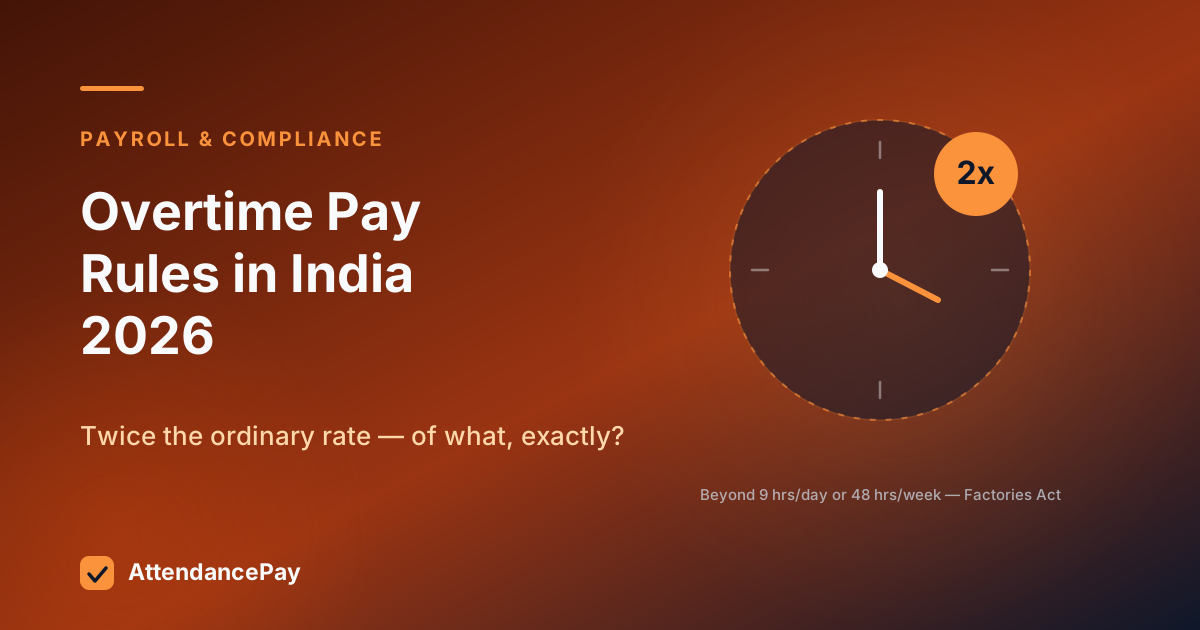
The clearest and most widely cited rule is in the Factories Act: where a worker works beyond nine hours in a day or forty-eight hours in a week, they are entitled to wages at twice the ordinary rate for the overtime. The Act also caps total hours and requires overtime records. Shops and commercial establishments are governed instead by the relevant state Shops and Establishments Act, and those set their own daily and weekly limits and their own overtime provisions — often, but not always, also at twice the ordinary rate.
The Code on Wages carries the principle forward with a uniform overtime rule of at least twice the normal rate of wages, which is intended to reduce the state-by-state variation once it is fully in force. Until then, the honest position is that the exact threshold and rate depend on which Act covers your establishment and which state you operate in. Confirm the applicable Act and current limits for your own state and category rather than assuming the Factories Act figures apply everywhere.
"Twice the ordinary rate" — of what, exactly
The expensive mistake is not the multiplier; it is the base the multiplier is applied to. "Ordinary rate of wages" is a defined thing, and it is not the same as gross salary and not the same as basic alone. It generally means the basic wage plus allowances that the worker is regularly entitled to, expressed as a per-hour rate — but excluding bonus and certain other payments.
Two companies can both pay "double overtime" and arrive at very different figures because one computed the hourly rate on basic and the other on a fuller wage base. Decide, in writing, what your ordinary hourly rate is composed of, and apply it consistently. Getting this wrong in either direction is a problem: too low underpays workers and invites a claim; too high quietly inflates every overtime run.
Overtime is an attendance problem before it is a payroll problem
Here is the part most overtime discussions skip. The rate is fixed by law and the wage base is a policy decision you make once. The variable — the thing that changes every single pay cycle and determines the actual rupees — is how many overtime hours were worked. And that number does not live in payroll. It lives in attendance.
If attendance is captured loosely — a register, a rounded in-time, a "he stayed late, pay him for two hours" — then overtime is being paid on estimates, and estimates in payroll are either a cost leak or a dispute waiting to happen. Overtime is only as accurate as the clock-in and clock-out behind it.
This is why the durable fix for overtime is upstream. When attendance is captured precisely and the hours flow into payroll automatically, overtime stops being a monthly negotiation and becomes a calculation. AttendancePay's overtime engine works off the actual attendance record and a configurable rate source, so the extra hours a worker put in are the extra hours they are paid for — no parallel timesheet, no rounding by memory. You can read how precise capture also closes other gaps in attendance management.
The mistakes that show up in real runs
- Paying overtime on gross including bonus. Overstates the rate; the ordinary rate excludes bonus.
- Paying a flat "OT allowance" instead of the statutory multiple. A fixed monthly amount is not overtime and does not discharge the legal obligation if hours exceed the threshold.
- No overtime records. The Factories Act requires them; "we paid it, we just did not log the hours" is not a defence.
- Rounding hours generously and inconsistently. Small per-instance, large per-year, and impossible to reconcile without the underlying punches.
Getting it right
Fix overtime in this order: confirm the Act and rate that apply to your establishment and state; write down the ordinary hourly-rate base and apply it uniformly; and make sure overtime hours come from real attendance data rather than estimates. The rate is the law's problem. The base is a one-time decision. The hours are the daily discipline — and they are where the money actually is. If you want to sanity-check what an hourly rate looks like against a monthly salary, the free salary calculator is a quick way in, and the recurring payable-days confusion that also trips up overtime is unpacked in why your payable days never match.