An employee resigns, serves notice, and leaves on good terms. Weeks later, the full and final settlement is still open, HR and the ex-employee are exchanging increasingly tense emails, and nobody can quite agree on the number. This is the normal state of F&F in a lot of Indian companies, and it is almost never caused by the exit itself. It is caused by data that was never kept straight during employment and only becomes visible when everything has to be reconciled at once.
What a full and final settlement is
The F&F is the single reconciliation that closes out the employment relationship — everything the company still owes the employee, minus everything the employee still owes the company, settled in one calculation after the last working day. It applies to resignations, terminations and retirements alike, and getting it right matters disproportionately because it is the last financial impression the company leaves, and often the one that ends up in front of a labour authority if it goes wrong.
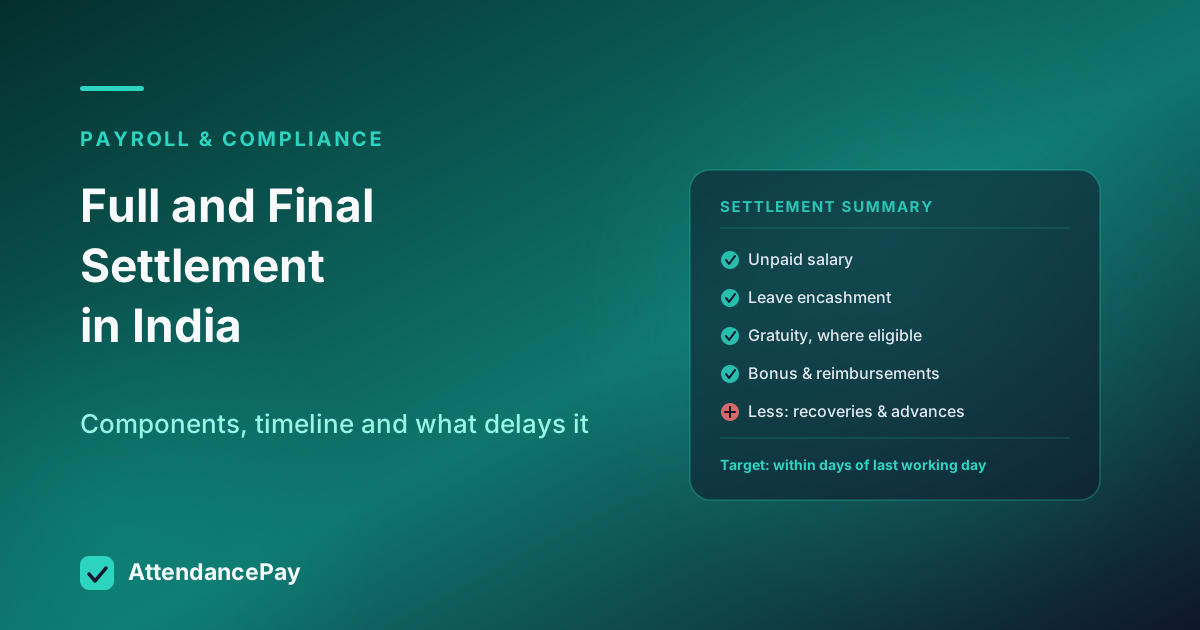
The components — what goes in
On the payable side:
- Unpaid salary. Salary for the days worked in the final month, up to the last working day, on the correct payable-days basis.
- Leave encashment. The balance of earned/privilege leave, encashed at the wage base your policy specifies (usually basic, or basic plus DA). This is where a clean carry-forward and encashment policy pays off — see our leave policy guide.
- Gratuity, where eligible. Payable under the Payment of Gratuity Act to employees who have completed the qualifying continuous service. Eligibility and the exact calculation are specific enough that they deserve their own check — the free gratuity calculator shows the standard formula.
- Bonus and incentives. Any statutory or contractual bonus and earned incentives due up to exit.
- Pending reimbursements. Approved expense claims not yet paid.
On the recovery side:
- Notice-period shortfall. Where the employee serves less than the required notice, a recovery in lieu — or, the other way round, notice pay owed to the employee where the company waives service.
- Advances and loans. Outstanding salary advances or company loans.
- Statutory deductions. PF, ESIC, professional tax and TDS on the settlement components that attract them.
- Asset recoveries. The cost of unreturned company property, where policy provides for it.
The net of those two sides is the settlement figure. None of the individual items is complicated. The difficulty is that they are scattered across leave records, attendance, the payroll ledger, the assets register and the reimbursements queue — and the F&F is the first time anyone tries to pull them into a single number.
When it is due
Timeliness is not a courtesy; it is increasingly a legal expectation. The Code on Wages moves toward requiring wages due on cessation of employment to be paid within two working days of the last day. Even where the older state rules still apply and allow longer, a settlement that drifts for weeks is both a compliance risk and a reputational one. Treat the target as days, not months, and design the process so it can actually hit that.
Why F&F is really slow — and the fix
The delay is almost always upstream. If leave balances were never reconciled during the year, encashment has to be recomputed from scratch and argued over. If attendance for the final month is not clean, unpaid salary is an estimate. If approved-but-unpaid reimbursements live in email, they get missed and reopened. The exit did not create these gaps; it exposed them all on the same day.
So the real fix for slow settlements is not a faster F&F process — it is keeping the underlying records straight throughout employment so that at exit there is nothing left to reconstruct. When leave balances, payable days and one-time payments and recoveries are all maintained continuously, the settlement is a summation, not an investigation. AttendancePay is built around that idea: leave and attendance feed a single payable-days figure, and one-time earnings and recoveries are first-class ledger items rather than notes in a spreadsheet, so the settlement assembles from data that is already correct.
A settlement that does not drift: the checklist
- Final-month payable days are confirmed from clean attendance, not estimated.
- Leave balance is current on the last working day, and encashment uses the policy's stated wage base.
- Gratuity eligibility is checked against actual continuous service, not assumed.
- Every advance, loan, pending reimbursement and unreturned asset is captured before the number is finalised.
- Statutory deductions are applied to the settlement components that attract them.
- The whole thing is targeted in days from the last working day, in line with where the wage code is heading.
Run that against your last few settlements. If any of them took weeks, the cause will be one of the first four lines — a record that was not kept straight while the person was still employed. That is the thing to fix, and it is fixed long before anyone resigns.