Almost every leave policy reads well on the day it is written and breaks the first time it meets payroll. The approval flow is the easy part — an employee applies, a manager approves. The hard part is what happens next: how the balance was earned, whether it can be carried forward, what happens to the days that lapse, and how a half-day of unpaid leave on a Friday before a holiday should be treated. Get those wrong and payroll spends every cycle reconciling by hand.
This guide is about writing a leave policy that a payroll system can actually calculate, not just one that sounds fair in the handbook.
The leave types Indian companies actually run
There is no single national leave law. Leave entitlements come from the state Shops and Establishments Act for offices and shops, and the Factories Act for factories, and the two differ. On top of the statutory floor, most companies grant additional leave as policy. In practice the categories look like this:
- Earned leave (also called privilege leave or annual leave). Accrues with days worked and is usually the only category that can be carried forward and encashed. This is the leave the statutes are most specific about.
- Casual leave. Short, unplanned absences. Typically cannot be carried forward and lapses at year end.
- Sick leave. For illness, sometimes requiring a certificate beyond a threshold of days. Carry-forward rules vary widely by policy and state.
- Paid holidays. National holidays plus the state's festival holiday list — separate from leave, but they interact with leave (see sandwich leave below).
- Special leave. Maternity (governed by the Maternity Benefit Act), paternity, bereavement, marriage — each with its own rules.
The single most useful decision you can make early is to keep the number of leave types small. Every additional type multiplies the accrual rules, the carry-forward rules and the payroll edge cases. A company with fifteen leave types is not more generous than one with four; it is just harder to run correctly.
Accrual: the part that decides everything downstream
How leave is earned determines every later question. There are two common models:
- Annual grant. The full year's entitlement appears on day one. Simple to understand, but it over-credits anyone who leaves mid-year, which then has to be clawed back at exit.
- Monthly (or per-day) accrual. Leave is earned in proportion to service — for example, a fixed number of days each month, or one day of earned leave for every twenty days worked, which is the shape the Factories Act uses. This is more work to track but far more accurate, and it makes mid-year exits clean because the balance is always what the employee has genuinely earned.
Whichever you choose, write down the accrual rule as a formula, not a sentence. "Employees get 18 days a year" is ambiguous. "1.5 days of earned leave accrue at the end of each completed month of service" is something a system can execute and an employee can check.
This is exactly where a leave module earns its keep. In AttendancePay, leave accrues automatically on the schedule you configure, so the balance an employee sees and the balance payroll uses are the same number — there is no month-end spreadsheet where the two quietly diverge.
Carry-forward and the cap nobody sets
Carry-forward is where policies get expensive by accident. If earned leave carries forward with no ceiling, balances compound year after year, and because earned leave is usually encashable, you are accruing a growing cash liability on the balance sheet without noticing.
Two numbers make this safe:
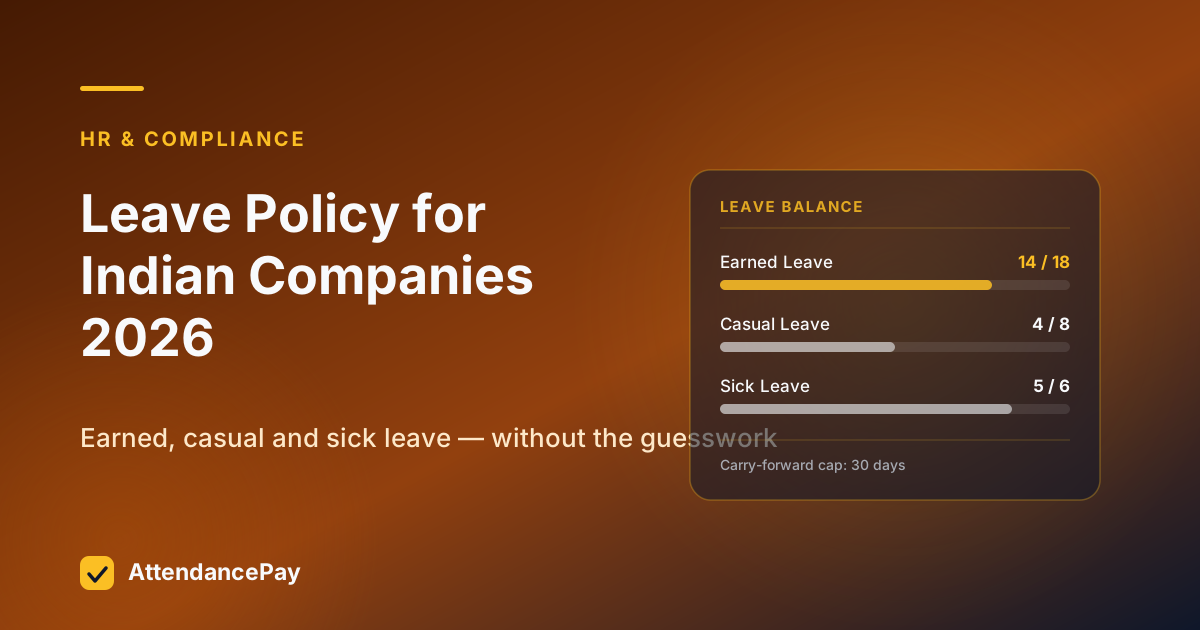
- A carry-forward cap — the maximum earned-leave balance an employee may bring into the new year. Days above the cap either lapse or are encashed, per your policy.
- An accumulation cap — the maximum total balance that can ever build up, which the statutes in several states also impose.
State your caps explicitly and state what happens to the excess. "Carries forward, capped at 30 days, excess lapses at 31 March" is unambiguous. "Carries forward" is a liability with no ceiling.
Encashment, loss of pay, and the sandwich question
Encashment converts unused earned leave to cash — most often at exit, sometimes annually. The rate is usually the employee's basic (or basic plus dearness allowance), not gross, and your policy should say which. Encashment on gross is a common and costly drafting error.
Loss of pay (LOP) is what happens when an employee is absent with no leave balance to cover it. LOP is not a leave type; it is the absence of one, and it reduces payable days directly. The cleanest policies define exactly when an unapproved or uncovered absence becomes LOP, so nobody argues about it at payroll time.
Sandwich leave is the rule some companies apply where a weekend or holiday falling between two leave days (or two absences) is itself counted as leave. It is legal as a policy choice, but it is contentious, and it must be spelled out precisely or it will be applied inconsistently. AttendancePay supports an attendance-based sandwich policy that is off by default — the right default, because sandwich rules should be a deliberate decision, not something that silently docks pay.
A policy payroll can run: the checklist
- Every leave type has a written accrual formula, not a sentence.
- Carry-forward and accumulation each have an explicit numeric cap, and the fate of excess days is stated.
- Encashment names its wage base (basic, or basic + DA) and when it applies.
- The moment an uncovered absence becomes LOP is defined.
- Sandwich treatment is either off or precisely described — never implied.
- The leave year (calendar or financial) is stated, because it anchors lapse and carry-forward.
Run that checklist against your current policy and the gaps will be obvious — they are almost always in accrual and carry-forward, the two rules employees never read and payroll can never guess.
Once the rules are written this way, the software is straightforward. The failure mode is never the tool; it is a policy that was never precise enough for any tool to execute. If you also want to see how leave balances flow into a payroll run, the mechanics of payable days are covered in our note on why payable days never match, and you can sanity-check a net figure with the free salary calculator.