A restaurant's busiest hours — lunch service, dinner service, a festival weekend — are exactly the hours when its scheduling and payroll problems are hardest to ignore. Split shifts around the gap between lunch and dinner, hourly kitchen and service staff working alongside a handful of monthly-salaried management, and overtime that is not occasional but structurally guaranteed on every weekend and every holiday. Generic HR software, built around a single continuous shift and a monthly salary, was not designed for any of this.
Split shifts are the normal shape of hospitality work, not an exception
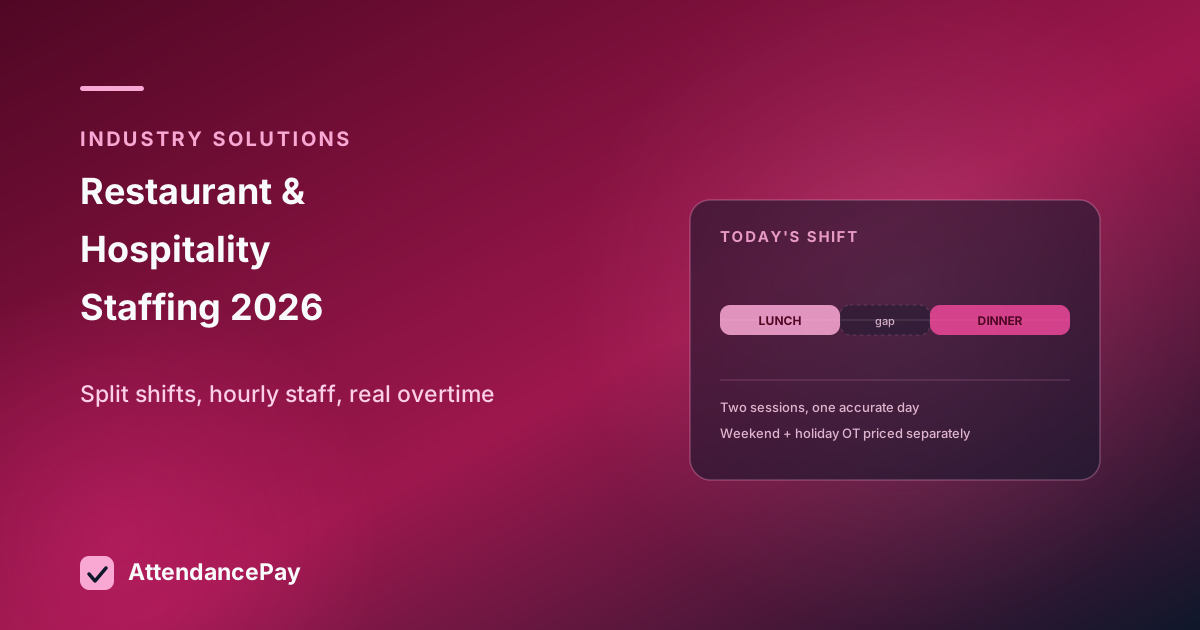
A server or cook working an 11 am to 3 pm lunch block and a 6 pm to 11 pm dinner block, with a genuine unpaid gap in between, is standard in restaurants and much of hospitality — and it needs to be recorded as exactly that: two working sessions in a day, not a single long shift with a mysterious hole in the middle that reads as an early departure it was never meant to be. Support for duties broken across a day is built in specifically for this shape of work, alongside standard rotating and night shifts for hotel operations that run around the clock. See shift and roster management.
Hourly wages for service and kitchen staff, monthly for management — together
Most restaurants and many hotels pay service and kitchen staff hourly while management runs on a monthly salary, and both groups need to be paid correctly in the same payroll cycle. Salary type is set per employee, hourly staff are paid from recorded hours at their configured rate with overtime applied, and monthly staff are paid on payable days — settled together in one run rather than as two separate payroll processes that have to be reconciled against each other afterward. See payroll management and how attendance becomes payroll.
Weekend and holiday overtime, because in hospitality that is most weeks
Unlike an office where a public holiday is a day off, hospitality staff frequently work the busiest festival and weekend periods — which means holiday and weekend overtime is not a rare event to review by hand but a routine part of nearly every pay cycle. Weekend overtime and holiday overtime can carry different, explicitly configured multipliers, priced from a fixed rate or from the employee's own pay, with a minimum threshold and daily cap so a small rounding difference cannot become a large unreviewed payout during a busy month. See overtime management, and the statutory basis in overtime pay rules in India.
Attendance policy that fits a fast, physical floor
Grace periods, half-day thresholds and overtime eligibility can be configured to match how a kitchen or service floor actually runs, rather than an office-style nine-to-six assumption — and different roles (kitchen, service, management) can be assigned different policies within the same restaurant or hotel where that genuinely reflects how the work differs. See attendance policies.
What to check before choosing a system for a restaurant or hotel
- Can a split shift with a genuine unpaid gap be recorded correctly, rather than as an early departure or a single long shift?
- Can hourly service/kitchen staff and monthly management be paid in the same payroll run?
- Are weekend and holiday overtime priced separately, given how often hospitality staff actually work those days?
- Can kitchen, service and management staff each run under a policy suited to how their role actually works?
A restaurant or hotel that can answer yes to all four has found a system built for how hospitality actually staffs a shift — not a generic HRMS asked to approximate it.