What is Provident Fund (PF) in India?
Provident Fund (PF), officially known as the Employees' Provident Fund (EPF), is a mandatory retirement savings scheme governed by the Employees' Provident Fund Organisation (EPFO) under the EPF & MP Act, 1952. Every employer with 20 or more employees must register under EPFO.
Who Must Register for PF?
PF registration is mandatory if your organisation has:
- 20 or more employees at any point in time, OR
- Fewer than 20 employees but voluntarily opts in
Once registered, even if headcount falls below 20, the obligation continues.
PF Contribution Rates (2024)
Both employer and employee contribute to PF every month:
- Employee contribution: 12% of Basic Salary + Dearness Allowance (DA)
- Employer contribution: 12% of Basic + DA — split as:
- 3.67% goes to EPF (Employee Provident Fund)
- 8.33% goes to EPS (Employee Pension Scheme) — capped at ₹1,250/month
PF Wage Ceiling
The statutory wage ceiling for PF is ₹15,000 per month (Basic + DA). This means:
- If an employee's Basic + DA is ₹15,000 or less → PF is calculated on the actual amount
- If Basic + DA exceeds ₹15,000 → PF can be calculated on ₹15,000 (statutory minimum), though many employers choose to calculate on the actual amount
PF Calculation Formula with Example
Let's take an example:
- Employee Basic Salary: ₹20,000/month
- DA: ₹2,000/month
- PF-eligible wages: ₹22,000 (but capped at ₹15,000 for statutory calculation)
Employee PF deduction: 12% × ₹15,000 = ₹1,800/month
Employer EPF contribution: 3.67% × ₹15,000 = ₹550/month
Employer EPS contribution: 8.33% × ₹15,000 = ₹1,249.50 → rounded to ₹1,250/month
Total employer contribution: ₹1,800/month
Additional Employer Charges
Beyond the 12% contribution, employers pay:
- EDLI (Employee Deposit Linked Insurance): 0.5% of PF wages (max ₹75/month)
- EPF Admin charges: 0.5% of PF wages (min ₹500/month)
How to File PF Returns (ECR)
- Log in to the EPFO Employer Portal (unified.epfindia.gov.in)
- Go to ECR → Upload ECR
- Upload the ECR (Electronic Challan cum Return) file — a text file with employee-wise wage and contribution data
- Generate the challan and pay online via net banking
- Deadline: 15th of the following month
Common PF Mistakes Employers Make
- Excluding allowances that should be part of PF wages
- Missing the 15th-of-month payment deadline (attracts interest and damages)
- Not updating the EPFO portal when employees join/leave
- Calculating PF on gross salary instead of Basic + DA only
How AttendancePay Automates PF Calculation
Manually calculating PF for 50–500 employees every month is time-consuming and error-prone. AttendancePay automates the entire payroll compliance workflow:
- Auto-calculates PF, ESI, PT, and TDS based on each employee's salary structure
- Generates ECR files ready for EPFO upload in one click
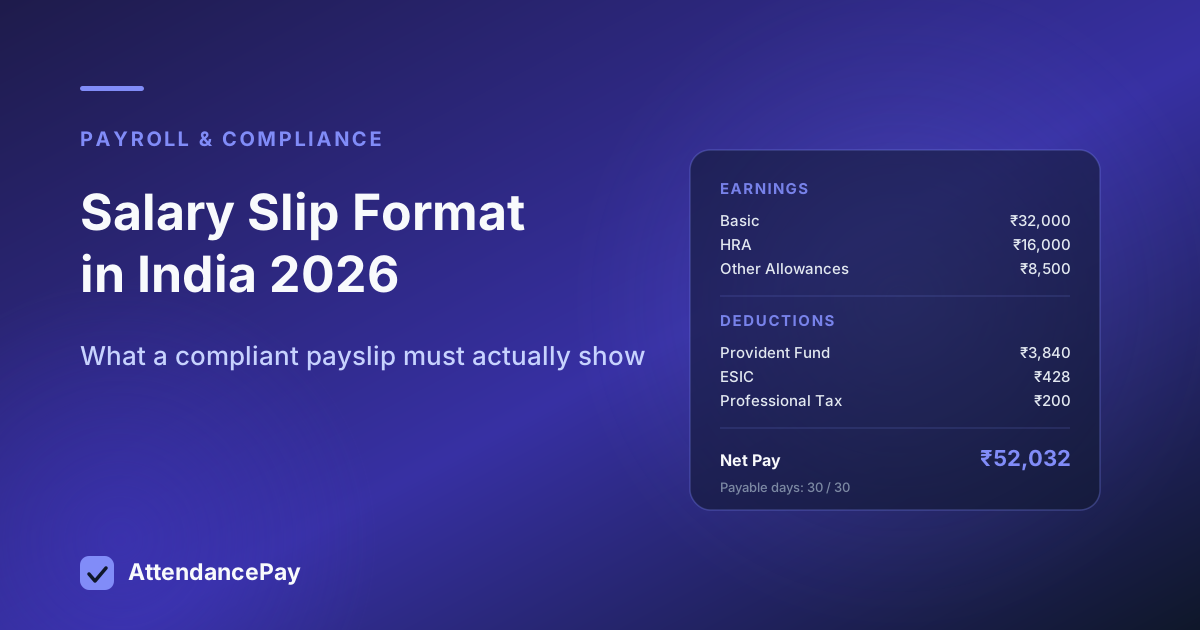
- Sends payslips with detailed PF breakdown to employees automatically
- Tracks PF eligibility when employees' salaries cross the wage ceiling
If you're spending hours on payroll compliance every month, start a free trial of AttendancePay and automate it completely.
Frequently Asked Questions
Is PF applicable on contract employees?
Yes — if contract workers are on your payroll and earn below ₹15,000/month Basic + DA, PF is mandatory.
Can an employee opt out of PF?
Only employees whose Basic + DA exceeds ₹15,000 at the time of joining can choose not to contribute. Existing members cannot opt out.
What happens if PF is not paid on time?
Late payment attracts interest at 12% per annum plus possible prosecution under the EPF Act.
Related tools: Use our free PF Calculator to work out contributions instantly, or see the Take-Home Salary Calculator for a full CTC-to-in-hand breakdown.