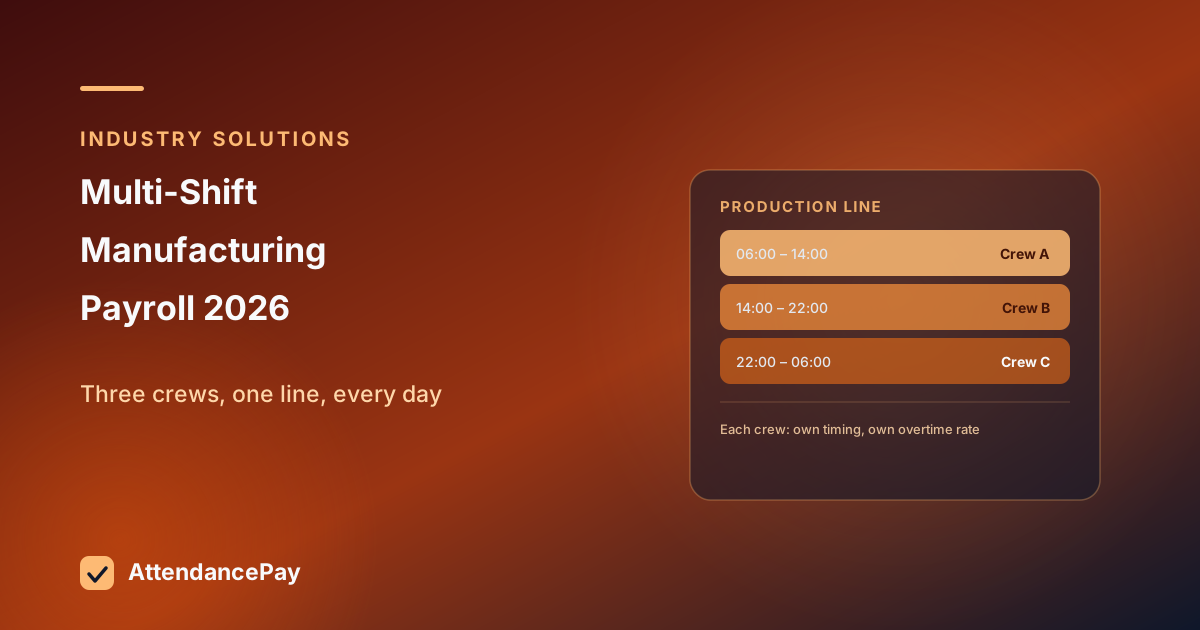
A three-shift manufacturing plant runs the same production line under three different crews, every single day, without the line ever actually stopping. The attendance and payroll challenge this creates is not simply "more shifts to track" — it is that each crew genuinely needs its own timing, its own grace period, and its own overtime baseline, evaluated correctly for every worker, every day, without the correction workload landing on a shift supervisor at the end of every cycle.
Why a single company-wide shift setting fails a plant immediately
A day crew starting at 6 am, an evening crew starting at 2 pm, and a night crew starting at 10 pm cannot be measured against one timing without two of the three crews being marked late or absent against a schedule that was never theirs. This is the most basic requirement a manufacturing plant has of its attendance system, and it is also the one most generic office-oriented software gets wrong first, because it was built around the assumption that a company runs one shift.
Per-crew shift assignment, not a company-wide default with exceptions
Each worker is assigned their own shift, and rotation across crews — day this week, night the next — is a pattern the system tracks rather than something a supervisor holds in memory. An overnight shift crossing midnight is treated as one continuous working session, not split into two confusing partial days, which is the single most common way night-shift manufacturing attendance goes wrong elsewhere. See shift and roster management for the full mechanics.
Attendance policy that reflects genuinely different shift populations
A night crew and a day-shift administrative team reasonably need different grace periods and different late-mark thresholds — measuring a night-shift worker against a day-shift standard produces late marks that are noise, not signal. Attendance policy is assigned per employee, so a plant running three shifts plus an administrative day shift can configure rules that fit each population correctly, in one system. See attendance policies.
Overtime priced against what the Factories Act actually requires
Manufacturing is where the Factories Act's overtime provisions apply most directly, and a production line running extended hours to meet a delivery deadline generates a real, recurring overtime liability that has to be priced correctly — against the shift a worker was actually rostered on, not a generic eight-hour assumption. Configurable weekend and holiday multipliers, a fixed or salary-linked rate, and a daily cap keep this both compliant and predictable. See overtime management, and the statutory detail in overtime pay rules in India.
Payroll for a plant that mixes wage types across its workforce
Production-line workers are frequently paid hourly while supervisors and administrative staff are salaried monthly — a single payroll run needs to settle both correctly, with hourly staff paid from recorded hours and monthly staff paid on payable days. See payroll management and how attendance becomes payroll.
What to check before choosing a system for a multi-shift plant
- Can each crew be assigned its own shift timing and grace period, evaluated correctly against that shift specifically?
- Are overnight shifts treated as one working session rather than split across two calendar days?
- Is overtime calculated against the rostered shift, with weekend and holiday rates priced separately?
- Can hourly production staff and monthly-salaried supervisors be paid in the same payroll run?
A plant that can answer yes to all four has a system built for how manufacturing actually staffs a production line around the clock — not a generic HRMS asked to approximate three shifts it was never designed to represent. See our manufacturing industry page for the wider picture.