A paper register costs almost nothing to buy and a great deal to run. Live GPS tracking is the reverse. Most comparisons of the two are written by vendors and reach a predictable conclusion, so this one includes the cases where the register wins.
Accuracy
Manual: records what someone wrote down. A register at an unattended gate records what the last person to sign chose to write, for themselves and occasionally for others. There is no verification of time or presence.
Live tracking: records a verified location at a verified time, continuously through the working session. The gap in reliability is not marginal — it is the difference between a claim and evidence.
Administrative effort
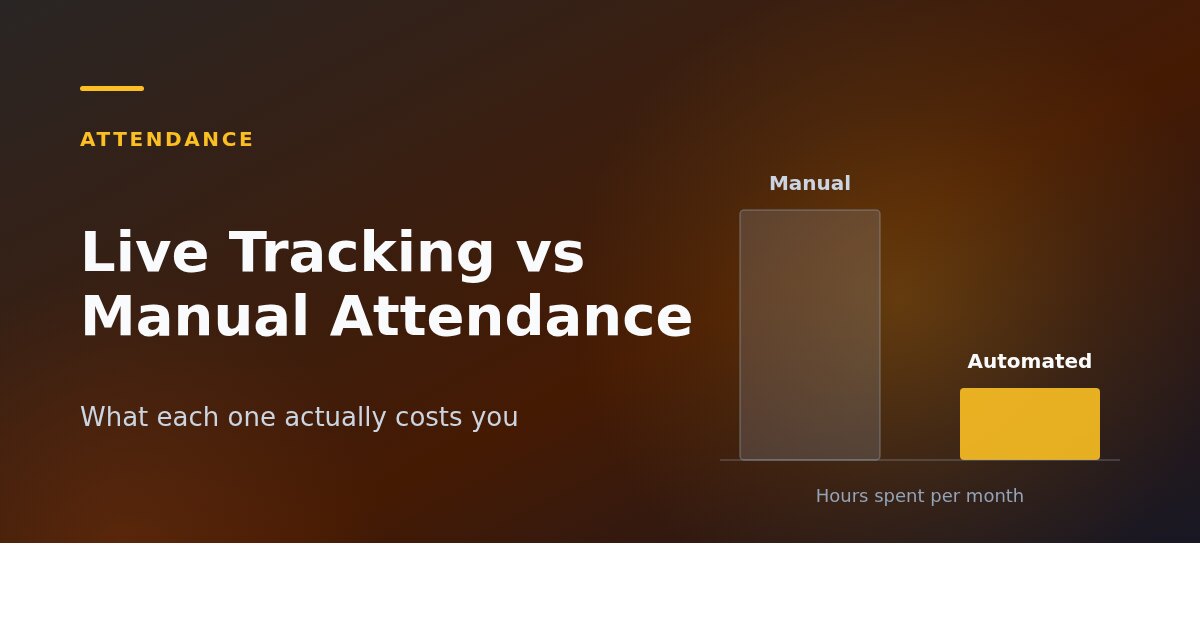
Manual: the cost is invisible because it is distributed. Someone collects registers, someone transcribes them, someone reconciles the transcription against leave, and someone resolves the discrepancies. For a few hundred employees this is routinely several days a month, and every one of those hours carries transcription risk.
Live tracking: attendance and distance are computed from captured data and feed payroll directly. The residual effort is reviewing exceptions, which is a smaller and more useful task than transcription.
Dispute resolution
This is where the difference is starkest and it rarely appears in a business case. When an employee disputes a salary deduction, or a customer says a visit never happened, manual attendance offers nothing — the company defaults to believing whoever is more senior, which is corrosive in both directions. With route history and timestamped check-ins there is a record, and disputes end quickly on evidence rather than on hierarchy.
Cost
Compare like for like. The register's true cost is the administrative time plus the unrecovered payroll leakage from unverifiable attendance. Live tracking's cost is per-employee licensing plus a real rollout effort. Run both against your own headcount before deciding; for small, single-site, desk-based teams the register frequently still wins on total cost, and any vendor telling you otherwise is not doing the arithmetic honestly.
The trust cost
Manual attendance is not experienced as intrusive. Live tracking can be, and that cost is real even though it does not appear on an invoice. It is also largely controllable: tracking bound to the working session, visible to the employee, and stopping at punch-out is a materially different proposition from continuous background monitoring. Live employee tracking is built to that boundary — recording starts at punch-in, ends at punch-out, and is visible to staff while active — because a boundary enforced by the product is one employees can verify, unlike a boundary promised in a policy document.
When manual attendance is still the right answer
- Small single-site teams where the manager sees everyone daily and reconciliation takes minutes.
- Fully desk-based staff where location adds nothing that a network login does not already establish.
- Sites with no usable mobile coverage, where a kiosk or biometric device is the better upgrade path rather than GPS.
- Workforces where trust is already strained — introducing tracking mid-conflict reliably makes things worse, whatever the operational case.
The middle option most companies actually need
The choice is rarely binary. Verified attendance — a location-stamped punch at check-in and check-out — captures most of the accuracy and dispute-resolution benefit without continuous tracking at all. For a large number of businesses that is the correct destination, and continuous live tracking should be reserved for the teams with a genuine operational need: dispatch, route verification, and travel reimbursement at scale.
If you are unsure, start there. It is easier to add continuous tracking later for the teams that need it than to withdraw it from a workforce that has decided you do not trust them.