Most field tracking rollouts do not fail on technology. They fail in the first week, when the team decides what the system is for — and once a sales team concludes it exists to catch them, the data quality degrades permanently. Reps learn what the system measures and produce exactly that, which is usually not what you wanted.
Start with the questions, not the tool
Sales managers need to answer two things: is the territory being covered, and is the coverage producing anything. Everything worth tracking follows from those. Everything that does not follow from them is surveillance, and it costs more than it returns.
Why visit count is a poor metric
"Forty visits this week" is the number most teams start with and the one that misleads fastest. It says nothing about whether the right forty accounts were visited. A rep can hit the target by repeatedly calling on the easiest, nearest, friendliest customers while the accounts that actually matter go untouched. The metric is satisfied and the territory is not covered.
Worse, visit count punishes reps with large or rural territories. Someone covering 200 kilometres for four substantial meetings is not underperforming against a colleague doing eight calls within a five-kilometre radius — but a league table sorted by visit count says they are, and that is how good people leave.
Metrics that hold up
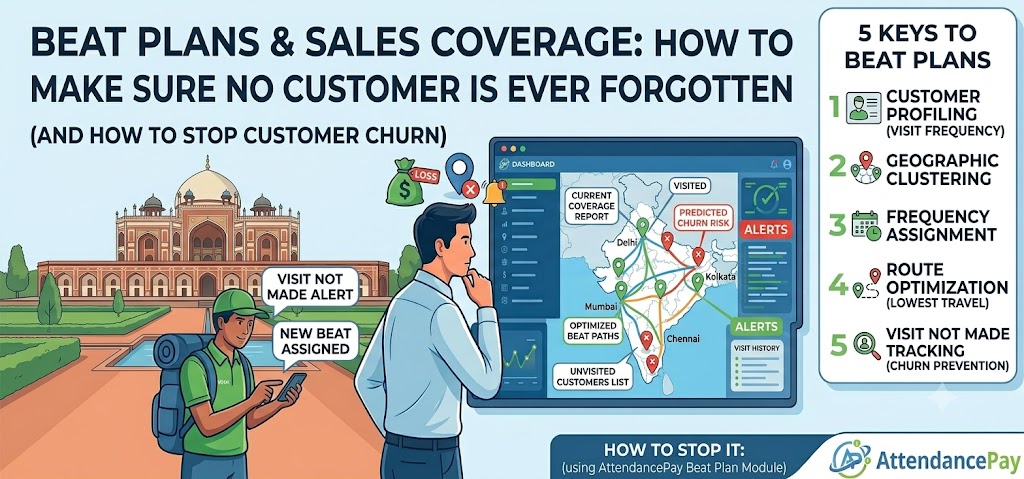
- Coverage against plan. Which accounts were due a visit this cycle, and which actually got one. This is the number that answers the real question, and it needs a beat plan to measure against.
- Accounts overdue. A running list of customers not visited within their intended frequency. Far more actionable than any aggregate, because each line is a task.
- Time on site. Check-in to check-out duration distinguishes a substantive meeting from a token appearance, without asking anyone to self-report it.
- Outcome capture. Orders, competitor activity, complaints, next action — recorded during the visit on a structured form rather than reconstructed at 9pm.
- Distance covered. Essential context for everything above, and the basis for reimbursement that neither side has to argue about.
Sales visit tracking computes these continuously rather than at month end, which matters more than it sounds: a coverage gap found on the 8th can still be fixed, and the same gap found on the 30th is just a post-mortem.
The reporting problem you can remove immediately
Before asking a team to accept tracking, notice what you can give them. Most reps spend somewhere between thirty and sixty minutes a day writing up visits — from memory, badly, after the useful details have faded. If check-in and a structured form during the visit replaces the evening write-up, you have handed back real time and improved the data at the same time. Lead the rollout with that, because it is true and it is the part reps care about.
Rolling it out without losing your best people
- Say what it is for, precisely. Fair territory allocation, accurate reimbursement, no evening paperwork. Vague framing gets filled in with the worst interpretation.
- Show reps their own data first. A rep who can see their own coverage and travel is a participant. One who only knows their manager can see it is a subject.
- Fix reimbursement in week one. Nothing builds acceptance faster than travel claims that get paid without a negotiation, and the distance data does that immediately.
- Do not run a league table in month one. Early data reflects varying adoption more than varying performance, and ranking people on it teaches them to game it.
- Coach on patterns, not incidents. "Three of your top accounts have not been visited in six weeks" is a useful conversation. "You were at a customer for only eleven minutes on Tuesday" is not, and it will be the only thing the team remembers.
Be honest about the trade-off
Location tracking is a real intrusion, and pretending otherwise is what generates resistance. The defensible position is a narrow one: track during working hours only, make it visible to the employee, collect what answers the two questions at the top of this article, and nothing else. That is a boundary you can state plainly to a team — and a boundary you can state plainly is one they can hold you to.