Ask most sales managers how their field team is doing and they’ll quote a visit count. “My reps do 10–12 visits a day.” It feels like the right number to watch. It isn’t — or at least, it’s only half of one.
Because a visit count only tells you about the customers your reps chose to visit. It says nothing about the ones they didn’t. And the customers who quietly stop getting visited are exactly the ones you’re about to lose.
The metric that actually predicts lost revenue
Flip the question. Instead of “how many visits did we make,” ask “which of our customers haven’t been visited in 30 days?”
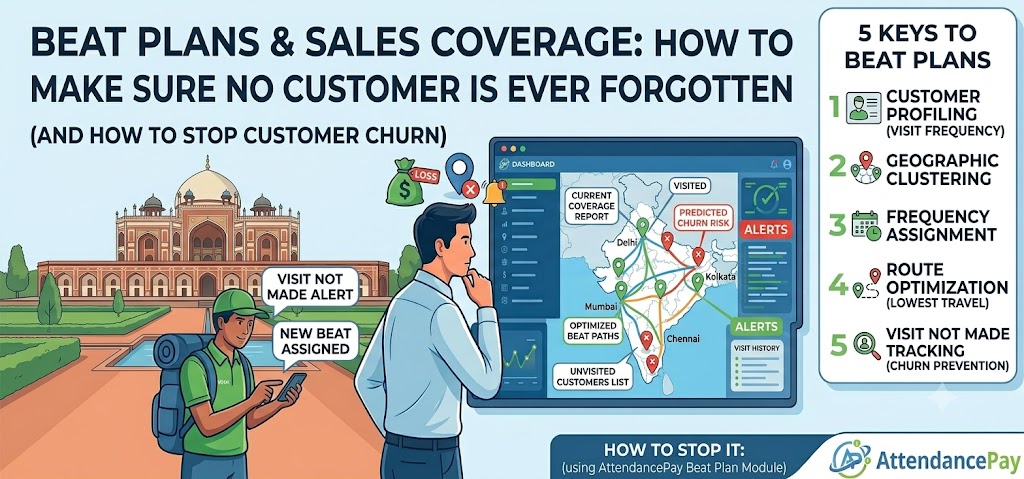
This one number — call it coverage — is powerful for a reason a visit count never can be: a rep cannot improve it by working the easy accounts harder. They can inflate their visit count by calling on the same three friendly shops every week. They cannot hide a distributor who hasn’t seen anyone in six weeks. Coverage forces attention onto the accounts going quiet, which is where churn begins.
What a beat plan really is
A “beat” is simply the route and set of outlets a rep is responsible for. A beat plan turns a vague territory into a rhythm: these shops, on these days, at this frequency. Done well, it does three things:
- Guarantees frequency. Every A-class outlet gets seen every week, every B-class one every fortnight — by design, not by whoever the rep felt like visiting.
- Makes gaps visible. When a planned outlet isn’t visited, it shows up. Without a plan, an un-visited shop is invisible until the order stops coming.
- Makes accountability possible. If every customer has an owner, then when an outlet goes quiet, one specific person is responsible for it — not “the sales team” in general.
Beat ownership vs. beat restriction
A common confusion worth clearing up: assigning an owner to a customer should not stop other reps from visiting them. In the real world, coverage is a team sport — a colleague covers when someone is on leave, a senior joins a key call. Locking a customer to one rep just creates friction.
The point of an owner isn’t exclusivity. It’s accountability: so your coverage report can answer “which of this rep’s customers have gone unvisited,” and somebody is on the hook for each quiet outlet. AttendancePay treats it exactly this way — any rep can visit any customer, but each customer has an owner so coverage is answerable per person.
How to run a coverage discipline
- Classify your outlets. A/B/C by value or volume. Your A-class accounts justify weekly visits; your C-class ones perhaps monthly.
- Assign owners. Every outlet gets a responsible rep — for accountability, not exclusivity.
- Set a frequency target per class, and let the system tell you who’s slipping.
- Review the coverage report weekly, not the visit count. Start every review with the customers who’ve gone dark.
- Act on the gaps. A distributor unvisited for a month is a reactivation call today — before a competitor’s rep makes it first.
The compounding payoff
Companies that manage coverage instead of just visit counts tend to find the same thing: a surprising number of accounts had quietly gone cold — not lost, just neglected — and most can be won back with a single timely visit. That’s revenue you already had, saved before it walked out the door.
Make coverage automatic
AttendancePay Field Visit Reporting tracks coverage for you: every visit is GPS-verified, every customer has an owner, and the coverage report surfaces exactly which outlets have gone unvisited — so no customer is ever quietly forgotten. Start a free trial and see your coverage gaps this week.