Every sales manager with a field team has had the same quiet worry: did my rep actually visit all nine parties today, or did three of those happen from a tea stall? The frustrating part is that on paper, a padded day and an honest day look identical. Nine names, a few notes, a petrol claim.
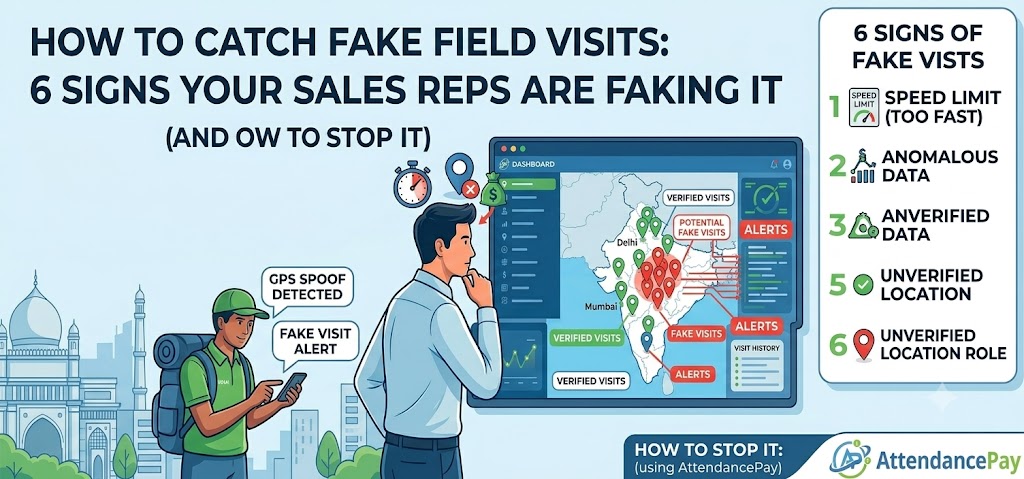
The good news is that fabricated visits leave patterns. Here are the six signs to watch for — and, at the end, the subtle loophole that lets a fake visit pass a distance check cleanly.
1. The GPS is spoofed
Free “fake GPS” apps let a phone report any location. A rep sitting at home can make their phone claim it’s standing in the market. There is no innocent explanation for a mock-location app running during a work visit — this is the one red flag with no benefit of the doubt. Any serious tracking system detects it automatically.
2. The check-in is far from the shop
The rep checked in, but a long way from where the shop actually is. Distance from the customer’s known location is the classic fraud signal — and when you see it on a map, with the direction and the metres, it’s hard to argue with. The catch is that this check is only as good as the customer location you’re measuring against (more on that below).
3. The visit was impossibly short
A ninety-second “visit” is not a sales call. If check-in and check-out are minutes apart, the rep drove past, tapped the app, and moved on. Set a minimum duration that makes sense for your business and let anything shorter surface for review.
4. The photo came from the gallery
Asking for a shopfront or shelf photo is a great discipline — but only if the photo was taken live. A photo pulled from the phone’s gallery could be from last month, or another shop entirely. The system should distinguish a live capture from a stored one, and flag the stored ones.
5. It was logged outside working hours
A visit recorded at 9 PM, when the rep wasn’t even punched in, deserves a second look. It might be genuine catch-up. It might not. Either way, you want to know.
6. The same shop, twice in one day
Sometimes perfectly innocent — a morning pitch and an evening order pickup. But two visits to the same party on the same day is worth a glance, because it’s also an easy way to inflate a visit count.
The loophole: when “right at the shop” proves nothing
Here is the sign almost nobody checks for, and it’s the one that quietly defeats every distance-based system.
Most tools verify a visit by comparing the rep’s location to the customer’s saved location. Reasonable. But who set the customer’s location? On most systems, it’s captured from the rep’s own phone on their first visit.
So picture a dishonest rep. On their very first “visit” to a shop, they log it from home. The shop is now permanently pinned at the rep’s house. From then on, every fake visit logged from that same sofa measures zero metres from the shop — and passes the distance check perfectly. The verification is certifying the fraud.
The only fix is to know who placed each pin. A location set by the same rep being checked isn’t independent evidence — it’s the rep vouching for themselves. AttendancePay flags this explicitly: if a visit passes the distance check against a location that same rep set, it’s marked for review with a plain-language note asking an admin to confirm the shop’s real position on a map. Once an admin pins it, the distance check finally means something.
The right way to handle a flag: review, don’t punish blindly
A crucial principle: flag, don’t block. Most odd-looking visits have innocent explanations — bad signal, a genuinely quick errand, a dense market. If your system blocks reps over these, they’ll resent the tool and stop using it, which costs you far more than the occasional padded visit. The right model is to let the visit through, raise a quiet flag, and let a human decide with the photos and the map in front of them.
And the real prize here isn’t catching the one dishonest rep. It’s that your honest reps finally have proof. Their work is visible, their numbers can’t be quietly doubted, and the whole team is measured on the same fair basis.
Put it into practice
AttendancePay Field Visit Reporting checks all six signs automatically — plus the self-set-location loophole — and surfaces only the visits that need a human. It’s part of the same attendance app your team already uses. Try it free and see your field day as it really happened.