Buddy punching — one employee clocking in for another — is the oldest attendance fraud there is, and it has outlived every generation of technology that records only when a punch happened. Punch cards, swipe cards, PIN entry, web check-in: all of them capture a timestamp, and a timestamp cannot tell you who was standing there.
The reason it persists is that it rarely feels like fraud to the people doing it. A colleague running twenty minutes late asks a friend to punch them in. Nobody sets out to steal from the company. But the effect on payroll is identical to theft, and because it is social rather than systematic, it spreads quietly through exactly the teams where supervision is thinnest.
Work out what it is actually costing you
Before buying anything, do the arithmetic on your own numbers rather than trusting a vendor statistic. The calculation is simple:
(Employees likely affected) × (minutes per incident) × (incidents per month) × (per-minute cost)
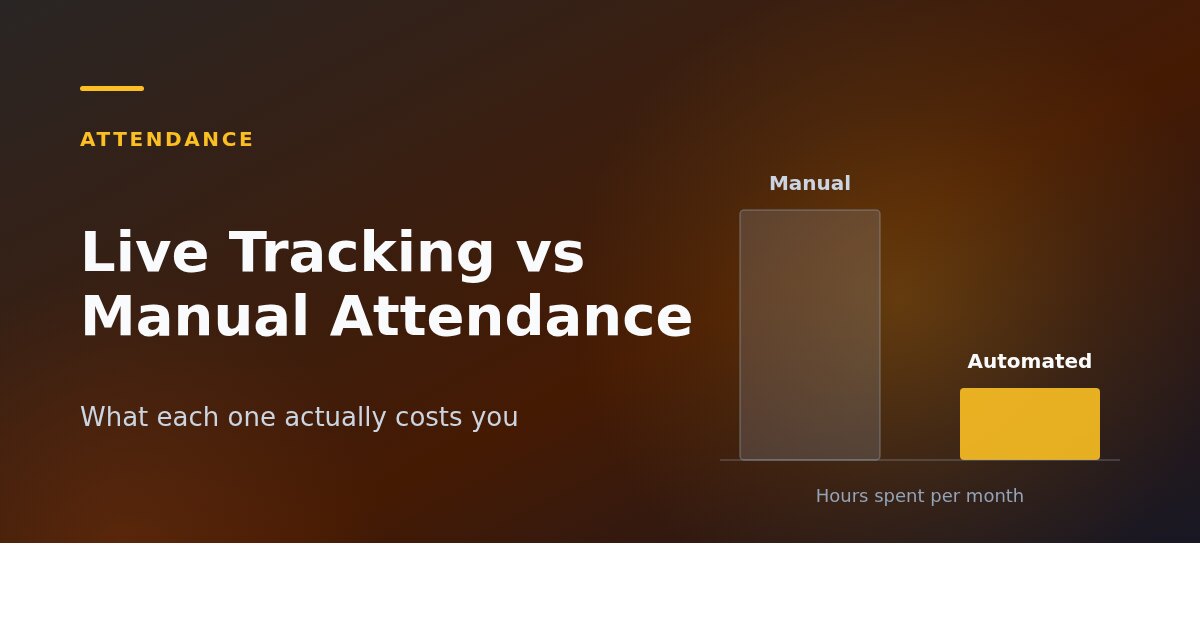
For a worked illustration: if 40 staff on a ₹25,000 monthly salary each have 20 minutes covered for them twice a month, that is 40 × 40 minutes = roughly 26 hours of unworked time paid every month. At an effective rate near ₹145 an hour that is close to ₹3,800 a month, or ₹45,000 a year — for one shift, at one site. Run your own figures. If the answer is small, you have just saved yourself a procurement exercise, and that is a legitimate outcome.
What location verification actually fixes
Adding location to a punch changes the problem meaningfully. GPS attendance captures coordinates at the moment of check-in, so a punch made from a colleague's house, from the bus, or from anywhere other than the assigned site is visible in the record rather than invisible in it.
Pair it with geofenced attendance and the check becomes a rule rather than a report. Each site carries a boundary; a punch outside it is flagged for approval or refused outright, according to the policy you set. The key shift is that exceptions now surface on the day they happen, when someone can still investigate, instead of during month-end reconciliation when the trail has gone cold.
Where GPS still falls short
Two gaps are worth being honest about, because vendors rarely volunteer them.
A phone can be handed over. If a colleague carries your phone to site and punches in from the correct location, GPS and geofencing both pass. Location answers where; it does not answer who. Closing that gap needs identity verification — which is what face attendance adds, by matching a selfie against the employee's enrolled template at the moment of the punch. Location plus identity together is substantially harder to defeat than either alone, and it is the combination worth aiming for.
GPS can be spoofed. Free apps let an Android phone report any coordinates it likes. If your attendance system cannot distinguish a genuine location fix from a simulated one, "GPS-verified" attendance is decorative. Ask any vendor directly whether they detect mock-location apps, and treat a vague answer as a no — an attendance control that a free app defeats is worse than no control, because it produces false confidence.
A sensible rollout order
- Measure first. Turn on location capture in report-only mode for a month. You will learn where the problem actually is, and it is frequently not where managers assume.
- Flag before you block. Blocking punches on day one generates a wave of angry exceptions, most of them legitimate — a badly sized geofence, poor GPS indoors, a genuine off-site start. Flag first, tune the configuration, then enforce.
- Add identity where the exposure is. Face verification everywhere is often unnecessary. Add it to the shifts and sites where the measurement showed a real problem.
- Tell people what you are doing and why. Attendance controls introduced without explanation are read as an accusation against everyone, including the large majority who were never doing it.
The point is deterrence, not prosecution
The goal is not to catch people. It is to make buddy punching visibly impractical, at which point it mostly stops. Companies that treat the first month's flagged punches as evidence for disciplinary action generally destroy more value in goodwill than they recover in payroll. Companies that fix the boundaries, explain the change and let the deterrent work usually find the numbers settle on their own.