
A field sales executive visits shops and offices. A medical representative visits doctors and chemists — and that difference changes almost everything about what "tracking" needs to mean. An MR's day is built around scheduled clinic hours, gatekeepers who control access, and calls that succeed or fail based on a two-minute conversation, not a transaction. Generic field-tracking software, built for retail beat plans, misses most of what actually matters in pharma field force management.
What MR tracking is actually trying to measure
Three things, and they are not the same thing:
- Coverage. Did the MR visit the doctors and chemists assigned to them, on the frequency the therapy area requires? A cardiologist who should be called on monthly and was last visited eleven weeks ago is a coverage gap, not a location data point.
- Call quality. Did the visit produce a real interaction — samples given, product detailed, a follow-up committed — or was it a doorstep drop-off logged as a completed call? This is the hardest thing to measure and the easiest to fake.
- Presence. Was the MR actually where they said they were? This is what GPS answers, and it answers only this.
Most "MR tracking" conversations focus entirely on the third point because it is the easiest to instrument. It is also the least informative one on its own — a GPS pin confirming presence outside a clinic proves nothing about whether the call happened, what was discussed, or whether it will move a prescription.
Where GPS is genuinely useful — and its real limits
Location tracking earns its place for two honest reasons: it verifies a call was logged from somewhere near the claimed doctor or chemist, and it gives sales managers a live view of territory coverage across a large field force without waiting for end-of-day reports. Both are real value.
What it cannot do is confirm the call itself happened as reported, or that it was any good. An MR can be genuinely present in a clinic's parking lot and never see the doctor. Treating a GPS ping as proof of a productive call is the same mistake as treating a punch-in as proof of a full day's work — we cover the general version of this in how GPS attendance stops buddy punching (and where it still falls short), and the pharma version of the same limit is worth taking seriously precisely because MR performance reviews often lean on visit counts as a proxy for results.
What closes the gap: reporting alongside location
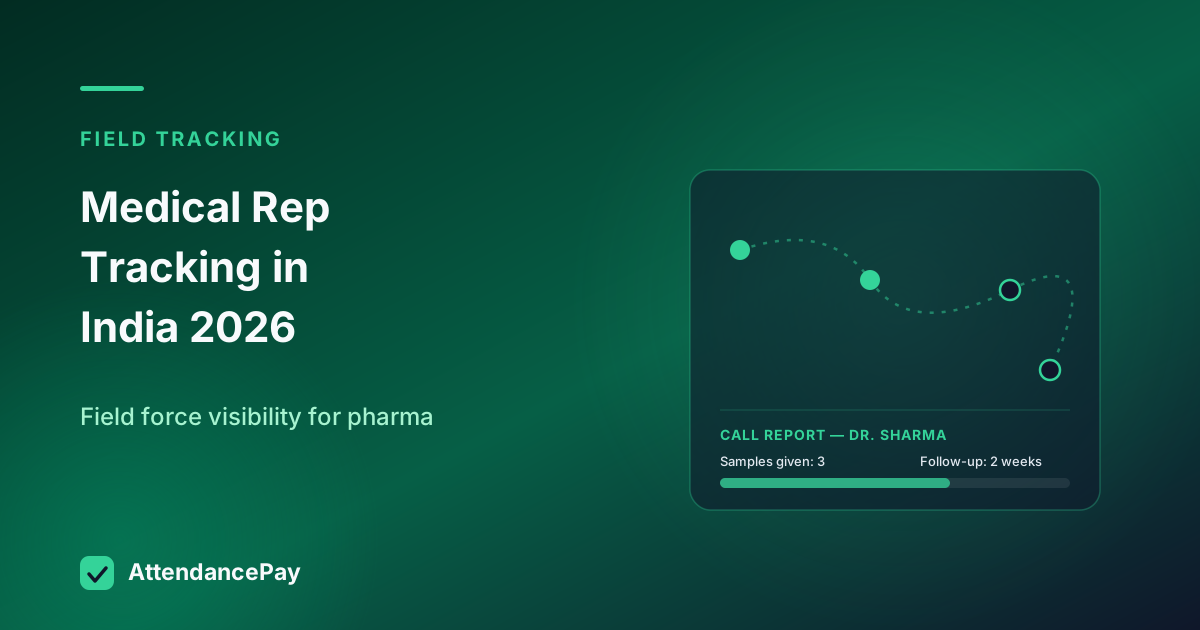
The answer is not to distrust GPS — it is to pair it with a structured call report the MR fills at the point of visit: doctor met, products detailed, samples given, next follow-up. A location-verified call with a substantive report is meaningfully different from a location-only ping, and the difference is visible immediately to a manager reviewing the day, not reconstructed weeks later from memory.
This is what turns field tracking into field force management rather than surveillance: the manager can see not just where the team went, but what happened when they got there, and can act on a coverage gap or a weak-quality pattern the same week it appears. AttendancePay's medical representative tracking is built around this pairing — location as verification, structured reporting as substance — and the same principle scales to any field force where the visit itself matters more than the trip, covered generally in sales visit tracking.
Beat plan adherence: the coverage question, made concrete
A beat plan assigns each MR a fixed rotation of doctors and chemists on a defined frequency. Adherence — did today's visits match today's plan — is the single number that turns "we tracked the team" into "we know our coverage is on schedule." Ad hoc visits that replace planned ones without a documented reason are the leading cause of quietly deteriorating coverage in a territory nobody notices until prescriptions drop. Our broader look at planning discipline is in beat plans and sales coverage.
The honest summary
MR tracking done well answers three questions together — where the team went, what happened when they got there, and whether that matched the plan — not just the first one. A field force tool that only shows dots on a map is solving the easy third of the problem. The value is in the reporting layered on top.